Business Waste Removal Sanderstead: Recycling & Sustainability
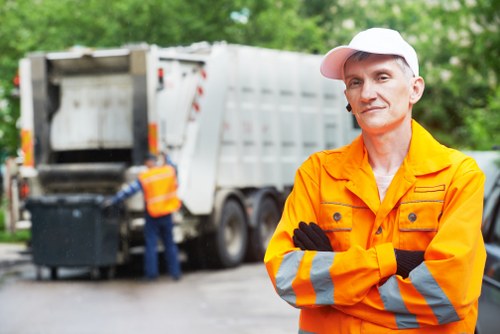 Business Waste Removal Sanderstead is committed to creating an eco-friendly waste disposal area across local commercial zones and industrial estates. Our approach balances practical rubbish removal with long-term environmental responsibility. In Sanderstead and the surrounding Croydon borough, businesses face growing expectations to separate recyclables, limit landfill, and reduce carbon emissions. This page explains our targets, operational partnerships, and the on-the-ground recycling activity that supports a sustainable rubbish area for local companies.
We set a clear recycling percentage target for all commercial contracts: a baseline of 65% recycling of non-hazardous business waste within 24 months of service start, with a stretch target of 75% through improved segregation, reuse and material recovery. This target applies to mixed recyclables, food and organic waste streams, and textiles diverted through reuse schemes. The recycling percentage target is monitored monthly and reported to customers so progress is visible and measurable.
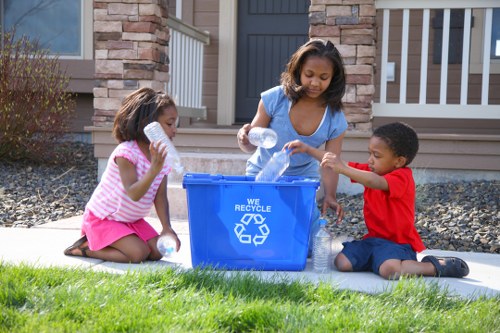 Our work aligns with the borough's approach to waste separation: encouraging dry recycling (paper, cardboard, tins, plastics), separate food and garden waste collections where available, and clear labelling to reduce contamination. We support business rubbish removal Sanderstead schemes that mirror local authority guidance and make it simple for commercial tenants to follow the same separation rules as household collections, improving overall recycling quality.
Local Transfer Stations and Resource Recovery
We use local transfer stations and materials recovery facilities to keep freight miles low and accelerate material sorting. Deliveries are routed to nearby Croydon and South London transfer hubs that specialise in commercial loads, enabling efficient consolidation and onward transport to dedicated recyclers. A strong local network reduces time on the road and helps sustain an eco-friendly waste disposal area by shortening supply chains.
 Partnerships with transfer stations allow us to separate streams on arrival, capture organics for anaerobic digestion, and direct glass and metals to high-value recycling processors. This network is central to our ability to reach and exceed the recycling percentage target while keeping processing local where possible.
We also operate a transparent waste hierarchy with practical steps for clients:
- Reduce – recommend operational changes to lower waste generation.
- Reuse – channel reusable items to partners and charities, extending product life.
- Recycle – segregate at source to hit recycling percentage targets and uplift material quality.
Charity Partnerships and Reuse Initiatives
We maintain close partnerships with local charities and social enterprises to maximize reuse of office furniture, textiles and electrical items. Through vetted collection streams, items that are still fit for purpose are redirected to community groups, reducing waste and supporting local needs. This charity collaboration is a core part of our commercial waste collection Sanderstead offering — turning disposal into social value.
 To prove impact we provide regular diversion reports showing volumes given to charity, tonnes recycled, and reductions in landfill. These outputs demonstrate how a sustainable rubbish area can also deliver social benefits and cost savings for businesses that choose reuse-first routes over landfill or incineration.
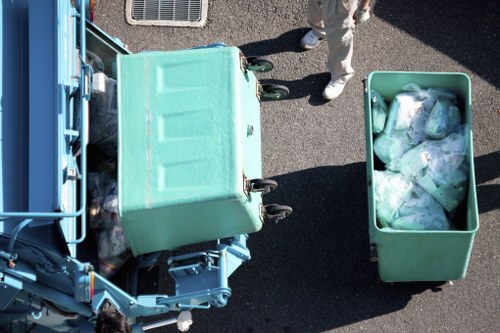 Our transport strategy supports a low-carbon fleet: a growing number of low-emission and electric vans handle local rounds, while route optimisation reduces mileage and idle time. By investing in low-carbon vans and driver training, we reduce the carbon footprint associated with each tonne of commercial waste collected. These measures complement the recycling percentage target by ensuring emissions fall alongside improved material recovery.
Operationally, we offer tailored collection frequencies and container solutions to suit different sectors — retail, hospitality, light industrial and offices — which helps keep contamination low and recycling percentages high. For example, restaurants are often directed to separate food waste into dedicated organic bins for anaerobic digestion, while offices receive clear desk-side recycling kits and paper shredding collection to maintain confidentiality without undermining material reuse.
Key outcomes we pursue:
- Meet or exceed 65% recycling within two years of service and progress towards a 75% stretch target.
- Increase reuse flows via charity partners and social enterprises.
- Maintain a low-carbon logistics approach through electric/low-emission vans and route optimisation.
Finally, Business Waste Removal Sanderstead remains focused on continual improvement. We provide periodic waste audits (without being a guide document) to identify new streams for diversion — from segregated glass and rigid plastics to pallet wrap and confidential paper. The combined effect of local transfer station use, charity partnerships, and a low-carbon fleet creates an integrated, sustainable rubbish area that benefits businesses, neighbourhoods and the wider environment.
By combining practical on-site segregation, clear recycling percentage targets, local processing, charity reuse channels and a low-emission vehicle fleet, we make it straightforward for Sanderstead organisations to meet sustainability goals. Our approach ensures commercial waste removal not only clears space, but returns value to the community and the circular economy.
Choose a partner that prioritises sustainability — a partner that transforms business waste removal in Sanderstead into a measurable, low-carbon contribution to a cleaner borough and a healthier planet.
